


3I/Atlas is creating a buzz. Here’s an analysis of where we are, and what it means.
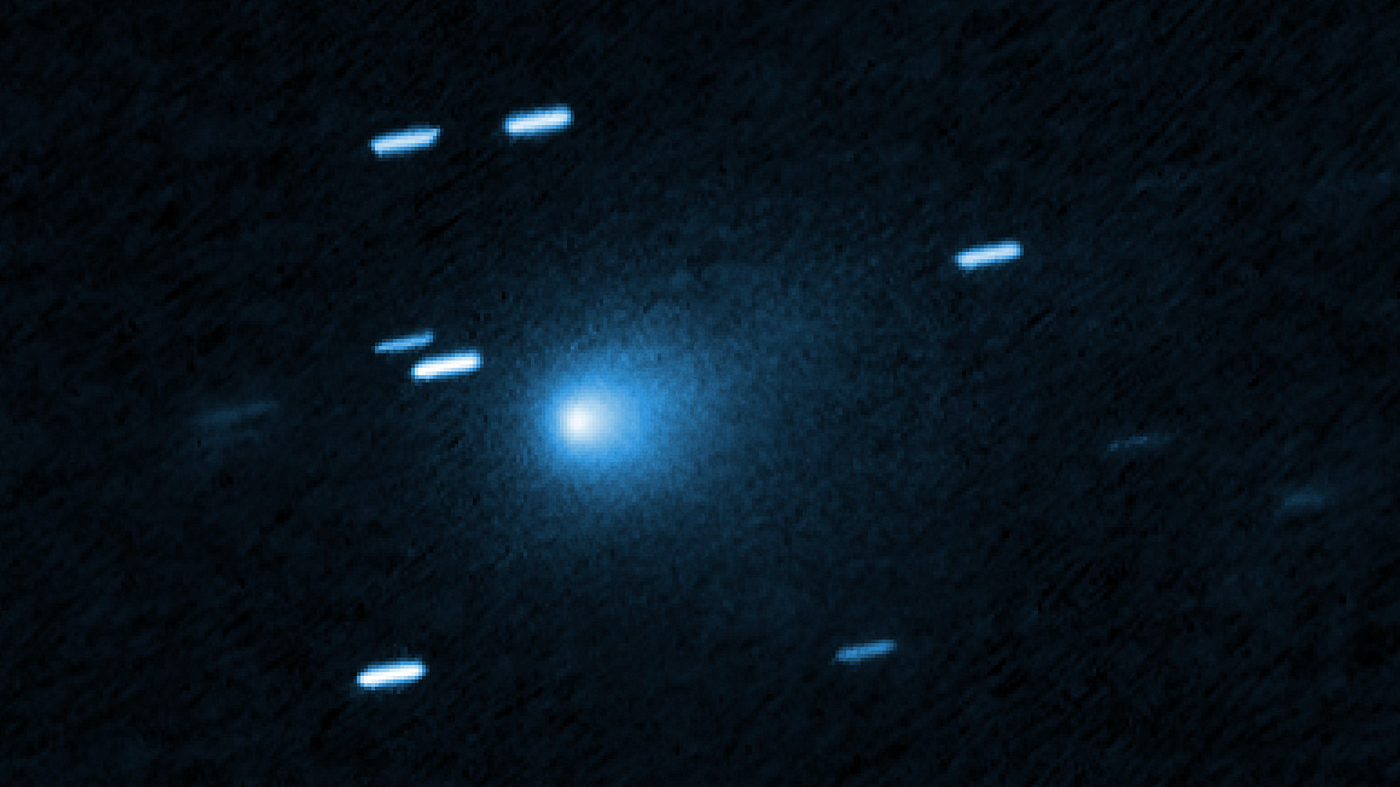
An interstellar object entered our solar system a few months ago — or more specifically the third interstellar object ever detected. The first was 1I/ʻOumuamua (itself sparking controversy), the second 2I/Borisov (a small comet displaying all the expected characteristics) and now, the third (3) interstellar (I) object detected by ATLAS (Asteroid Terrestrial-impact Last Alert System), named 3I/Atlas.
Let’s get this straight, any interstellar visitor, sentient or not, sparks excitement amongst the scientific community. It’s an extremely rare event. Our galaxy is large, with vast distances between star systems. The nearest star to us, Proxima Centauri, takes light from Earth over four years to reach (it takes light only one second to circle the Earth eight times).
According to Avi Loeb, Professor Emeritus at Harvard, what makes 3I/Atlas particularly interesting is its unvarying course, high-speed and (at least as it entered the solar system), its tail pointing in an odd direction. As a comet nears a star, the increased radiation to which it’s exposed causes gases to sublimate from crevices on and within its surface. These gases typically originate from frozen water, carbon dioxide (dry ice) and carbon monoxide. The sublimated gas jetting off a comet is akin to a propulsive force, changing its trajectory slightly as it does so. Combined, all the gas jetting off its surface in different directions creates a somewhat uncertain trajectory. On top of that, the cometary tail, which consists of plasma and dust particles, is typically pushed away from the star by radiative forcing (the star’s photons have momentum and actually produce a force when striking these particles) as well as by solar wind (charged protons and electrons emanating from the star).
Hence the very rigid trajectory and tail pointing towards the sun rather than away from it makes 3I/Atlas anomalous. It’s also rather large (3–4 miles in diameter) and passes strangely close to a number of planets, aligned as it is with the orbital plane of our solar system which is unlikely in itself; most interstellar objects pass through the plane. Avi also notes that in the 70s, an indisputably unnatural (or Wow!) signal was received from the same region of space 3I/Atlas would have been traversing. There’s a <5% chance of this occurring by accident (Loeb, 2025). His hypothesis is the signal might have come from the object itself.
It’s important to note that Prof. Loeb is very cautious in making a claim that 3I/Atlas is an alien object on a mission from another star system to survey us. He never explicitly states this. As a good scientist, he won’t, until there is irrefutable proof. All he wishes is that society study the object more closely and be on alert that the comet could be proof of extraterrestrial intelligence. Surely such an epoch-defining discovery merits serious consideration? As part of his efforts to mobilise society, he has expressed concern that images taken by NASA’s Mars Reconnaissance Orbiter (MRO), which hosts and will remain to host the closest human telescope to the object, have not yet been released. Taken at the beginning of October, NASA has cited difficulty releasing the images due to the government shutdown. This has stoked theories that NASA is intentionally withholding information from the public about what is in fact an alien object — something that NASA has a long history of doing.
So where does this all leave us today? 3I/Atlas is currently at its perihelion (closest approach to the sun), crossing the orbit of Mars on the opposite side of the Sun — we can see nothing due to the Sun’s glare (at least as long as NASA withholds data from MRO). It should become visible again towards the end of November. According to Avi, if it is an artificial object here to survey us, this point in its trajectory would be suitable for it to slow down and park itself in our solar system. We would immediately notice such an event by either not detecting it at all or seeing that it’s way off its ‘natural’ trajectory. On the other hand, we may find that it follows its current course without deviation. At which point people will surely suspect a ploy by the sentient object to disguise itself. And so, the extraterrestrial saga continues…
I find the first scenario highly improbable due to what is called the Dark Forest Theory. The theory goes (among physicists), that the galaxy is so full of tremendously advanced, potentially hostile civilisations, that it’s better for a small and less developed one to remain hidden — as detection could spell its demise. Similar to a dark forest, where large threats may remain hidden, yet nearby, you’d better not light a campfire revealing to all your location (and complacency). It seems to me that this would be proper ET policy — remaining undetectable or at least disguised, whether through an invisibility cloak, under the cover of an ‘interstellar comet’ or using other technological means.
Another reason is that we know that extraterrestrials have access to antigravity technology and are able to warp space and time to propel themselves between star systems within months if not weeks. The existence of antigravity technology has been revealed by former government intelligence workers in front of US congress in recent UAP investigations (Unidentified Anomalous Phenomena — expanded from ‘UFOs’ as objects are now not just seen flying, but also moving underwater). The public investigations, headed by Tim Burchett (R-Tennessee) and Anna Paulina Luna (R-Florida), have resulted in at least three hearings to date which have included testimonies by credible individuals including former Air Force pilots and intelligence officers with high security clearances. They reveal in no uncertain terms that alien ship retrievals (including retrievals of ‘biologics’, aka alien bodies) have been ongoing since the 40s. In his book ‘Imminent’, Lue Elizando, a former CIA worker tasked to unravel the UFO Pandora’s box hidden within the deep state, even claims that the US military has built and tested its own versions of these craft (Elizando, 2024). To add to this, the potential of propelling a ship by warping spacetime around it (antigravity) is an independently developed theory known to scientific community since the 90s (Alcubierre, 1994).
Extraterrestrials then do not tend to use traditional kinetic propulsion installed on an interstellar arc to visit other solar systems. And if 3I/Atlas really was this, then the inhabitants would be less advanced than the ETs currently among us, and therefore less of a threat. If we truly want to expand our consciousness into the Universe, and live up to the advanced beings we feel we are, we must start confronting the fact that our planet (and others in our solar system) have been visited by ETs for thousands of years, we are likely a genetic creation of an alien race and that we are extremely vulnerable to pretty much every alien civilisation out there today.

3I/Atlas is then the least of our worries, whatever the verdict on its trajectory later this month. We must open our eyes to what credible individuals are saying about the status of our involvement with ETs — individuals such as Lue Elizando but not incidentally, both the former head of Israel’s space program, Prof. Haim Eshed (Newsweek, 2020), and the former Minister of National Defence for Canada, Paul Hellyer (Hellyer, 2018), among others. We must see that humans have never been the singular civilised species in the Universe at the apex of conscious thought amongst inanimate matter and basic lifeforms, and that such a notion is not dissimilar from the Middle-Age assertion that Earth was at the centre of the solar system. We must stop fighting each other, stop competing with each other, realise we are all one bonded by the common experience of being human — and start consolidating our planetary defences as well as informing the public of the truth so they are mentally prepared.
The good news is that if an ET society really wanted to extinct us, they could’ve done so already. But to them, we’re really the equivalent of a lost indigenous tribe in the Amazon showing signs of intelligence, organisation and development; fascinating, worth studying but representing no real threat, yet. We can develop beyond our current status as an unaware, undeveloped and disorganised civilisation into one that is advanced, space-faring and aware of its place in the galaxy. We have the cognitive ability to reach the technological level of those aliens visiting us today. Our recipe for success is our unique ability to cooperate and build on the foundations of knowledge left by our ancestors. Though our lifespans are short, changing up the hierarchy so often actually makes for a more dynamic and flexible society. The democratic principles we have established, over the repression of past empires and kingdoms, allows for the emancipation of our population, and the ability for individuals to self-realise.
In short, we have the potential to raise our consciousness and expand our principles of freedom of thought and inalienable rights to the rest of the galaxy. And yes, it sounds like I’m writing a Star Trek series — but is it not curious how our visions for the future are generally self-fulfilling?
Read the original article here: https://medium.com/@mllewelynb/3i-atlas-a-wake-up-call-for-humanitys-next-step-into-space-28bd45f4ac10
References
Alcubierre, 1994, The warp drive: hyper-fast travel within general relativity, Miguel Alcubierre, Classical and Quantum Gravity.
Elizando, 2024, Imminent: Inside the Pentagon’s Hunt for UFOs, Luis Elizando, William Morrow.
Hellyer, 2018. Hope Restored: An Autobiography by Paul Hellyer: My Life and Views on Canada, the U.S., the World & the Universe, Paul Hellyer, Credos
Loeb, 2025, A Q&A on 3I/Atlas at Perihelion, Medium
Newsweek, 2020, Did Donald Trump Nearly Confirm Existence of Aliens? Isreali Ex-Space Chief Makes Bizarre Claim